Dude, Where's My Privacy?

Sunday, April 18, 2010


Often times Internet users reveal personal data that they don’t intend to share. Whether signing up for an account online or clicking on an advertisement, people you may never meet in person have information about you. Whether it’s a company or search engine, people have demographic data and potential employers may have something on you as well. Is there real privacy on the Internet? Can personal information be protected as they once were before the digital age? These topics will be explored in this blog post.


Some websites seem to know your gender and possibly some products that may interest you. Visiting some websites where I have an account, like Facebook.com, I have noticed that advertisements are geared around media, female fashion, film schools, and student credit cards. The demographic information in my Facebook Profile give companies like Facebook that kind of information. If you are registered with an account on a magazine website, you may notice advertisements tailored to fit your interests. Companies can do this because of cookies, little text files created on your computer that contain information left there by the websites you visit and the advertisements you have clicked on their site in the past (“Internet Use Raises Privacy Concerns”). More information on how the Internet affects privacy concerns can be found here.

There are websites like The Anonymizer that allow a user to conceal personal information when visiting websites that track cookies and demographics. This website can help protect online shopping and protect your privacy even if you are using an iPhone. The Internet impacts privacy on a large scale. There are so many companies looking for user information and there are thieves that are trying to find personal information to steal. With so much activity taking place online, from shopping to socializing, there are so many aspects of protecting privacy to consider.


A case involving an autistic student in Italy will be observed here. The autistic student was bullied at school and a video of the incident was posted online. The video could be found through Google and there was a total of 5,500 hits in two months. There were advertisements on the site, which meant that Google was profiting off of the posting of a video where a student is bullied. Making profits where the video was published was what got Google in trouble with an Italian court. More information on this topic can be found here. In my opinion, Italy's prosecution of Google is fair. There is a line between protecting privacy and promoting the free exchange of information. This video contained information that was embarrassing and harmful to the victim. These kinds of videos where people are harmed or bullied does not need to be shared, not even on  unless it is used as a democratizing tool. Videos on protests and brutal police attacks can be shown on websites because they are showing the truth of what is happening and why it needs to be stopped. This video should have been screened and censored by Google.

Here is a video on Internet privacy and security:


Companies like Yahoo! and Google keep track of user searches in order to help maximize searches and provide niche advertising. Other companies like magazines may mine the internet for user information in order to make better profits and attract people to their sites. They may want to sell something or get more hits to their site for better chances of increased revenue. The only way to stop companies to getting our information is to avoid clicking on advertisements and have firewall software installed on our computers. We should also clear our cookies and our History on our Internet browser every one or two weeks to prevent information from being stolen, even by hackers. People don't have too much control over a Google search and what people obtain about them. As long as people don't allow too much information about them on the web and don't sign up for too much on unsecured websites (ones with "https" links), then their most private information can be protected. From my own personal experience, I have stopped using external links on Facebook, stopped with quizzes and games, and only use my private information on sites like banking.
   
I don't believe there is absolute privacy on the web. We never know if a clickjacker or a certain virus that logs everything we type has been transmitted to our computers before our AntiVirus software has had a chance to update itself. I never use my card information on the web unless I have heightened my firewall and am using only the https website. Future employers can use sites like LinkedIn and blogs under your name to find out more information about you. When I googled myself and did a search on the web for myself so I could see what a potential employer could find, these are the four links I found:

http://www.casl.umd.umich.edu/index.php?id=685238
http://umd.typepad.com/shahnaz_09_10/ 
http://www.umd.umich.edu/2010orileaders/
http://www.casl.umd.umich.edu/index.php?id=685238

A few months ago, my Facebook account would appear in a Google search. I revised my privacy settings to avoid that from happening. People growing up in this generation may expect more privacy because almost every aspect of their life could be found on the Internet.  People nowadays use the Internet to store videos, pictures, conduct banking, play games and participate in social networking. With past generations, most activities were physical, and now almost everything can be done in cyberspace. More information on the privacy and the age demographics expectations on protection online can be found here.


All of the privacy issues affect the Long Tail of distribution because people can upload unlimited amounts of data and media on the Internet that can allow others to invade their privacy without permission. The Internet is a democratizing tool but someone's privacy is always invaded in the process. In the case of the autistic student in Italy, the privacy of the student was invaded. In the case of protests in Tehran, the government's privacy is invaded. With so much available online, users should always put their privacy first even when using social networking sites. Companies might use your information to target you with advertising, and search engines may track your searches. Thieves and marketing research companies keep track of your cookies and demographic data. The only way to protect ourselves and retain our privacy is to be careful with what we do online.


Works Cited:
All Images found via Creative Commons (in order of appearance):
http://farm4.static.flickr.com/3219/2998710223_d29e8eceb6.jpg

http://farm2.static.flickr.com/1391/1362625176_5347e65d48.jpg

http://www.flickr.com/photos/23905174@N00/1594411528/

http://www.online-educa.com/images/picture-gallery-09/resized/Online%20Educa_2178.jpg


All Videos found via Creative Commons.
Links:
Cleland, Scott. "Poll: Americans Strongly Oppose." The Precursor Blog. The Associated Press, 30 09 2009. Web. 17 Apr 2010. http://precursorblog.com/content/poll-americans-strongly-oppose-publicacy-expect-online-privacy-part-xvi-privacy-publicacy-series

Barry, Colleen. "Italian Judge Says Profit Behind Google Verdict ." Bloomberg Businessweek. The Associated Press, 29 04 2008. Web. 17 Apr 2010. http://www.businessweek.com/ap/financialnews/D9F1M8UG2.htm

"Internet Use Raises Privacy Concerns." VOA News. voanews/com, 29 04 2008. Web. 17 Apr 2010. http://www1.voanews.com/english/news/science-technology/a-13-2008-04-29-voa44.html


Lohr, Steve. "How Privacy Vanishes Online." Technology. The New York Times, 03 16 2010. Web. 17 Apr 2010. http://www.nytimes.com/2010/03/17/technology/17privacy.html

Perez, Sarah. "Three Facebook Settings Every User Should Check Now." Technology. The New York Times, 20 01 2010. Web. 17 Apr 2010. http://www.nytimes.com/external/readwriteweb/2010/01/20/20readwriteweb-the-3-facebook-settings-every-user-should-c-29287.html?em

Viral Networking

Wednesday, March 3, 2010

What does social networking mean to you? There are many different answers to this question depending on how you use social networking websites. Many people around the world come together with common interests to use sites like Facebook, YouTube, and Twitter, whether these people are individuals, businesses, or entrepreneurs. What purposes do these different media services offer to the public? How do companies benefit from these services when it comes to marketing and the long tail distribution? We will take a look at a few of the popular sites available to people and how they are a democratizing tool for millions worldwide.

Twitter began as a micro-blogging service that later grew as a social media and news reporting website. People began to use this site to write about their daily life knowing that a mass anonymous audience would have access to read it. Even people who are suffering crisis within their country can post updates to provide the world with information and pictures. Aside from individuals using Twitter, 34,000 jobs were posted on TwitJobSearch in January proving that job recruiters and seekers are using Twitter (Miller). Why does Twitter work for employers and potential employees? Unlike e-mail, a company doesn’t have to come up with a list of people who will receive the "I'm hiring" message because anybody searching can see it and it's a cheaper, faster and easier way to recruit (Miller).  Starbucks' Twitter is an example of one of the many Fortune 100 companies using social networking sites. Starbucks uses Twitter to let people know about any new changes to the company, new gift cards available as well as new flavors for fans to test. Being a Starbucks addict myself, this site is a great way for me to find out new changes.

Facebook is a popular social networking site with 350 million users worldwide (Schroeder). People use this site to communicate, upload and view photos, videos, and other content. Small businesses are creating fan pages and groups for users to join in order to find new customers, build online communities of fans and dig into gold mines of demographic information on its users (Pattison). As the image on the left conveys, a user can see any updates posted by a business on their homepage (known to users as the 'news feed'). Just like Twitter, users and businesses can post updates and announcements, even something as simple as, "New Flip Ultra HD custom skins available on our website" Then other people who are connected to the business would read it and maybe post comments. The update from Flip drew me to visit their website and spend a few minutes drooling over the custom skins I can put on my Flip. If used effectively, companies can upload fresh content and updates regularly as niche marketing. This form of target marketing conducted by Flip worked on me. This also applies to the Long Tail distribution because they can provide information for free and promote products on an endless shelf space, hoping users will be willing to make purchases. Musicians and film makers use Facebook and MySpace to promote their music. Remember the 2008 election? Obama counted more than 2 million American supporters on Facebook, while McCain had just over 600,000 (Fraser).


On YouTube, Obama stole the show as his supporters uploaded more than 1,800 videos onto the BarackObama.com channel (Fraser). His political campaign was promoted effectively via YouTube in terms of providing viewers with extra content about his promises of bringing about "change."

Universal Music and Hollywood Records are just two of the many companies that promote content online for viewers to enjoy. Through YouTube, companies can also keep track of ratings and how many people viewed videos. News organizations upload clips of news helping people stay updated. CNN is a prime example of this and such a YouTube link can be viewed here.


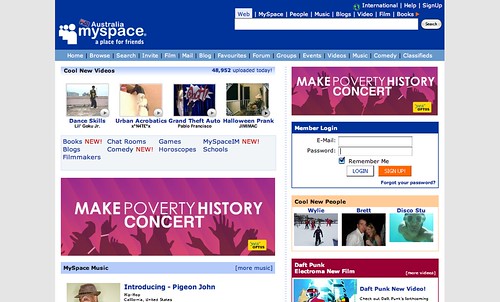
LinkedIn is a social networking website geared towards professionals trying to maintain contacts and information within the industry. This website standardizes information entered by users into predefined “Profile Headline”, “Summary”, “Education”, “Company”, etc. categories (Schaffer). People can use this site to find jobs as well. Google Buzz was created to compete with Twitter and Facebook, allowing users to have this social media site built directly into their Gmail. Here's a link to some success stories from businesses and individuals about their experiences using social networking sites. A new University of Maryland survey shows social media usage among small businesses increased to 24% in 2009, up from 12% in 2008 and 22% of those surveyed feel social networking is already helping them turn a profit, with 46% believing the marketing tool will help them make money within the next year ("ASI Central"). 

Below is a video that explains how businesses can use social networking sites as a business tool to connect with clients and build trust:


How do these social networking sites relate to the Long Tail distribution? Businesses can use these websites to promote their companies at a minimum or no cost. They can provide their content for free hoping to generate revenue. Individuals can exercise their freedom of speech by taking to Twitter and other sites to post their opinions and comments. Citizens unsatisfied with their government can post videos to raise awareness. Freedom of press allows journalists to convey their stories through social networking sites, especially on YouTube. The Internet is a democratizing tool and these social networking sites help provide people with a vast amount of information. Creative Commons allows people on these sites to protect their work via free licensing with "All Rights Reserved," "Some Rights Reserved," and so on. The video posted above was found on blip.tv with a Creative Commons license.

Thus, social networking sites are changing the way people have access to information. People can view these sites through their computers, phones, and tablets. Companies like Starbucks have been smart enough to follow their consumers online and create social networking profiles to promote their own agenda and build trust in the community. Creative Commons allows these companies and individuals to copyright their content as they utilize the long tail distribution technique and niche marketing. So yes, social networking is a means to communicate with people and receive updates on friends, but it is also a form of viral networking and marketing that is benefiting millions of people worldwide.


Works Cited:
Images/Video found via Creative Commons Google Image (in order of appearance):
Twitter Feed: Web. 2 Mar 2010. http://farm4.static.flickr.com/3333/3257942812_8d59f7a646_o.jpg

Tech Crunch Facebook: Web. 2 Mar 2010. http://farm3.static.flickr.com/2568/3769089178_45f74e3914.jpg

MySpace: Web. 3 Mar 2010. http://farm1.static.flickr.com/111/294080639_3682a8d88c.jpg

YouTube Jennifer Hudson Performance: Web. 3 Mar 2010. http://farm4.static.flickr.com/3495/3252665182_a663fb5337.jpg

Video: Web. 3 Mar 2010. http://blip.tv/play/AYGZqn8C" type="application/x-shockwave-flash
 

All Websites that were cited within the blog post:
"ASI Central." Social Networking Usage Doubles. 02 03 2010. Web. 2 Mar 2010. http://www.asicentral.com/asp/open/apps/news/industrynews.aspx?id=3715

Fraser, Mathew. "U.S. News and World Report." Barack Obama and the Facebook Election. 28 11 2008. Web. 3 Mar 2010. http://www.usnews.com/articles/opinion/2008/11/19/barack-obama-and-the-facebook-election.html?PageNr=2

Miller, Claire. "Twitter Could Become the Unemployed's Best Friend." The New York Times. 01 25 2010.
The New York Times Company, Web. 2 Mar 2010. http://bits.blogs.nytimes.com/2010/01/25/twitter-could-become-a-recruiters-best-friend/?scp=6&sq=twitter&st=cse.

Pattison, Kermit. "The New York Times." How to Market Your Business With Facebook. 11 11 2009. The New York Times Company, Web. 2 Mar 2010. http://www.nytimes.com/2009/11/12/business/smallbusiness/12guide.html?_r=1

Schroeder, Stan. "Mashable: The Social Media Guide." Facebook’s Road to 350 Million Users. 02 12 2009. Web. 2 Mar 2010. http://mashable.com/2009/12/02/facebook-350-million-users/

Schaffer, Neal. "Windmill Networking." What is LinkedIn and Why Should You Join?. Web. 3 Mar 2010. http://windmillnetworking.com/2009/08/26/what-is-linkedin-and-why-should-you-join/


Copyright 2010 Wordpress Themes